I Went to Gusto Three Times in One Day
- Admin
- 2 時間前
- 読了時間: 4分

Yesterday, I ate at Gusto three times in a single day.
In the morning.
In the late afternoon.
And at night.
It is not that I am a devoted fan of Gusto, a Japanese family restaurant chain.
It simply turned out that way.
⸻
Two or three months ago, I started doing upper-body strength training.
I have been training with fairly heavy resistance, hoping to build more muscle in my chest and back.
At the same time, I began sending photographs of every meal to a generative AI and asking it to evaluate what I was eating.
Calories.
Protein.
Fat.
Carbohydrates.
For each meal, it tells me what is missing.
⸻
For the past two or three months, I have eaten mostly Japanese set meals.
Grilled fish.
Sashimi.
Seafood rice bowls.
Occasionally, a shabu-shabu set meal.
Japanese food makes it relatively easy to consume protein while maintaining a balanced diet.
In that respect, it is excellent.
But when you eat it every day, even good food eventually becomes repetitive.
Grilled fish again.
Sashimi again.
It may be good for my body.
My mind, however, was beginning to grow tired of it.
⸻
Once you try to include plenty of protein in every meal, your options become more limited.
Ramen.
Fried rice.
Pasta.
Even when I want to eat something like that, I can already hear my AI teacher responding before I have sent the photograph.
“You do not have enough protein.”
⸻
I am not a particularly big eater.
I would rather enjoy something delicious than simply eat a large quantity.
Even when I am already quite full and send a photograph of my meal, the reply comes back:
“You still need more calories.”
Eat more.
It is still not enough.
My AI teacher shows no mercy.
⸻
After living like this for a while, a thought occurred to me.
Why not try Gusto?
In the morning, I went there and ate a grilled salmon set meal.
I then went to work and had a sashimi set meal at another restaurant for lunch.
So far, it was still the usual Japanese food.
⸻
That evening, I was planning to go to a milonga.
I was meeting a friend at 6:30 p.m., so I wanted to eat something light beforehand.
I therefore returned to Gusto.
This time, I ordered one of its hamburgers.
It was around five in the afternoon.
After so many Japanese set meals, the hamburger looked strangely refreshing.
It felt as though I were eating something other than fish for the first time in ages.
⸻
After that, I went to the milonga.
Several tango friends were there, and I danced quite a lot.
One tanda.
A short rest.
Then another tanda.
Before I knew it, I had done a considerable amount of exercise.
It was almost ten at night when I began driving home.
After all that dancing, I was a little hungry again.
So I headed back to Gusto.
It was my third visit of the day.
⸻
Gusto was offering a seasonal summer dish called:
“Chilled Soy Milk Tantan Udon with Fragrant Sesame.”
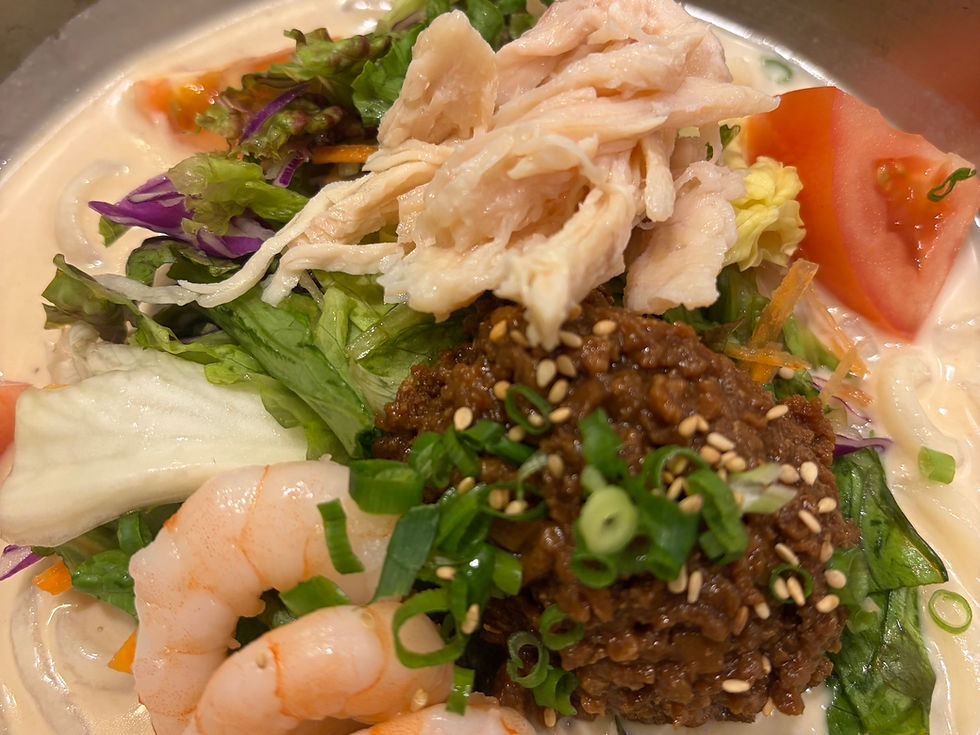
It looked perfect for a hot summer night.
Still, I suspected that the udon alone would not provide enough protein.
By now, I have become fairly skilled at finding ways to add protein to a meal.
Without hesitation, I added steamed chicken as a topping.
Chilled soy milk tantan udon with steamed chicken.
It was a surprisingly good combination.
⸻
Before eating, I took a photograph and sent it to my AI teacher.
The response was unexpected.
“92 points. Today’s best meal.”
Not the grilled salmon set meal.
Not the sashimi set meal.
The highest-scoring meal of the day was the chilled soy milk tantan udon from Gusto.
My decision to add steamed chicken was also highly praised.
I may finally be beginning to understand my AI teacher’s grading system.
⸻
Still, the amount of food I am expected to consume each day is considerable.
I complained about this to the AI.
It replied:
“Even under normal circumstances, you need approximately 2,500 kilocalories. If you want to build muscle, around 3,000 kilocalories is a reasonable target.”
My basal metabolic rate is approximately 1,900 kilocalories.
I am also expected to consume about 130 grams of protein each day.
Of course, these figures are only estimates.
Even so, actually eating that much is not easy.
Perhaps eating is simply another part of training.
⸻
Whenever my wife sees me doing strength training, she asks:
“What exactly are you trying to become?”
She has a point.
At a personal training gym I once attended, I was told:
“You have more lower-body muscle than anyone else in this gym.”
Years of tango had naturally trained my lower body.
My upper body, however, was another matter.
At most, I occasionally did some push-ups.
But ordinary push-ups no longer seem to provide enough resistance for me.
That is why I have begun incorporating pull-ups and dips as well.
⸻
I am not trying to become a bodybuilder.
I simply want a little more thickness in my chest.
When I dance tango, I want the lines from my shoulders through my chest and across my back to look a little better.
That is all.
Yet for this modest goal, I now photograph every meal, submit it to an AI for grading and try to consume 3,000 kilocalories a day.
⸻
Until recently, I had not realized how closely building muscle was connected to eating.
Strength training alone is not enough.
Without raw materials, the body has nothing from which to build itself.
So I have to eat.
But eating the same Japanese set meals every day eventually becomes tiresome.
That is where Gusto comes in.
A grilled salmon set meal in the morning.
A hamburger in the late afternoon.
Chilled soy milk tantan udon with steamed chicken at night.
Even at the same restaurant, the possibilities change depending on what you choose.
Thank goodness for Gusto.
⸻
I build muscle for tango.
I eat in order to build muscle.
And in order to eat, I go to Gusto.
That was my day yesterday.